
As long as your child is healthy, content and making progress and learning regularly every week, how you homeschool or home educate is entirely up to you.
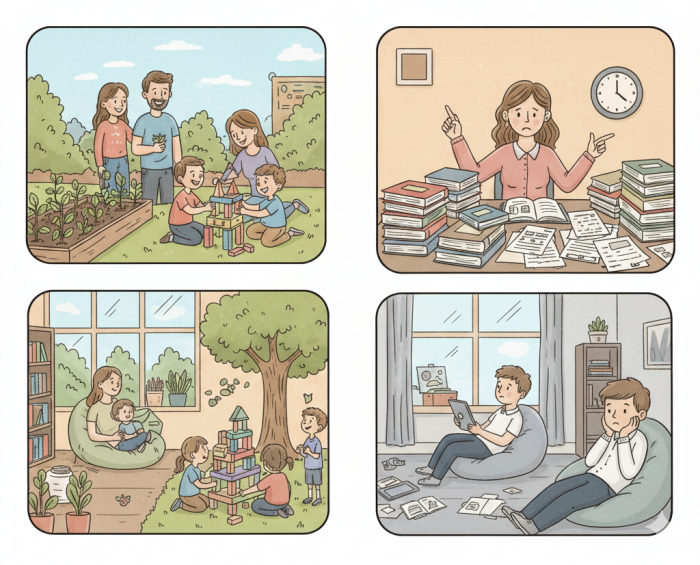
Also whilst we are on the topic lets talk about the terms for home schooling and home education.
Some people like to differentiate (and will be offended!) if you use the term homeschooling whilst they prefer to call it ‘home educating’ or even ‘elective home education’. This is because they view homeschooling as literally doing school at home which they despise and hate the idea of anyone trying to infringe on their freedom. (This is more of a UK thing).
Whilst others use the terms interchangeably and understand or view homeschooling and home educating as the same thing. I.e. learning at home or someplace out of mainstream school.
I personally tend to use the terms interchangeably. I find the term homeschooling is far more comprehensible to people who do not homeschool and I also think its a good idea to loosely follow the school curriculum so that we have some idea of milestones and lesson content. I then add on my own extras and move at the pace that I feel is right.
There are lots of differing attitudes in the home schooling community, some parents hate the thought of exams and any kind of pressure and some stick to very rigid schedules similar to school. Then you have other families doing a range of things in between. If you are new to homeschooling take your time to find what works for you and your children and then find other parents and families who have a similar rhythm and goals to yourself.
In this post I will break down different approaches with their pros and cons, hopefully this will give you some ideas to start planning your approach to homeschooling.
First: Decide what you want to achieve
Do you want your children to do GCSE exams and how many?
Do you want them to complete them early – if you are homeschooling it’s possible to complete some GCSEs by age 11 – 14 (my personal recommendation) which I will dive into in another post.
Or are you going to be more laid back and/or decide later?
Do you want your child to specialise in something completely different like a sport or art or chess? In that case that hobby will likely take up most of your child’s schedule.
What do your children want? If they are old enough and mature enough its worth having regular conversations with them so that you are all on the same page and not fighting a constant battle.
Timetables/Schedules
Option 1: Do it like School
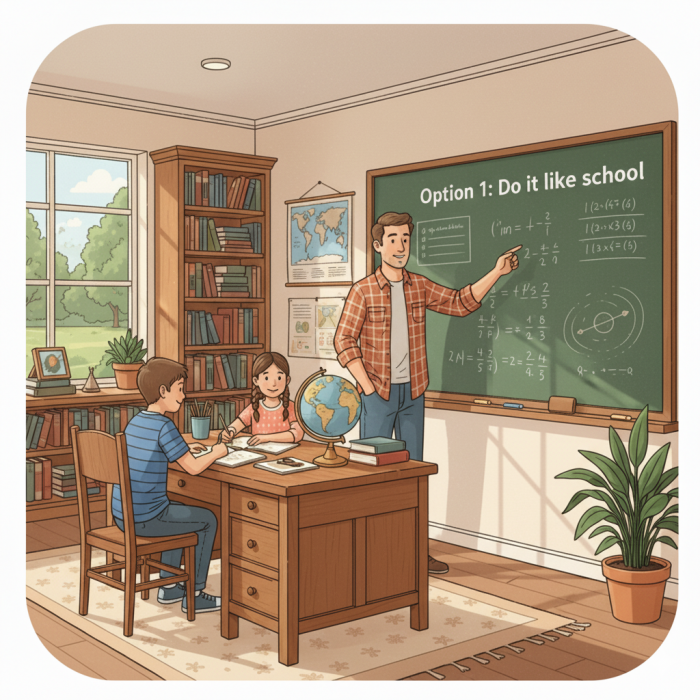
You can literally follow a typical school day, start at 9am, several lessons, and then finish at 3pm.
Pros:
Some children and families need that structure and organisation.
Works well for older teens who have deregistered from school and want to continue studying in a similar manner.
You can follow the school curriculum and use textbooks so you all know what to expect each day.
Lots of websites and resources available for this method.
You may even be able to stay in touch with a local or your previous school and get support.
Cons:
Requires constant supervision
You may need a specialist tutor or teacher for each lesson
You need a dedicated classroom space
Might be difficult depending on how many children you have and their age gaps
Option 2: Do it like school for half of the day or specific days of the week
You can do formal lessons starting at 9/10am and finish at 1pm.
Pros:
Less intensive for everyone
Children might work better if they have freedom in the afternoons or certain days
Might be easier to work with one child in the morning and another child in the afternoon
Might be easier for working parents
Cons:
Might take longer to complete work or cover a topic
Option 3: Choose a few core subjects to study in depth
For example you might just focus on reading and writing and basic maths if your child is under 7.
You can choose to go deep into maths, robotics and science with your preteens and teens if they are interested in those subjects.
If one of your children is a budding writer, they can spend most of their time learning how to write, complete writing courses and might even look into publishing a book or blog etc.
Pros:
Allows for mastery of a few key subjects
Allows children to follow their passions
Good for teenagers who want freedom in their education
Less expense as this method requires less tutors and resources
Cons
Won’t work if children aren’t focused well or don’t know what they enjoy
Option 4: Hardly any structure, mostly playing outside (please don’t do this all of the time)
Whilst this is great for early years, 0 to 5/6. And sometimes necessary for a few weeks or months if your children have recently deregistered from school or going through a tough situation. Its not my personal recommendation.
With the rise of the ‘unschooling’ parents on social media where parents are not teaching their children anything and whose children are falling behind in basic milestones such as not being able to read or write anything at age 6, having zero structure is a scary trend.
Please note, unschooling is not the same as learning through play.
Learning through play still has structure and learning objectives for each day or week. The difference is children don’t feel as though they are being forced to learn and it keeps them moving and playing as they learn instead of sitting at a desk.
Summary:
Those are the main type of approaches I can think of at the moment. Some families do a mix during the week or month. They may have 2 weeks of fully structured learning and then a few days to let the children just play or go deep into their areas of interest.
As I said at the beginning as long your children are making measurable progress each week, a mix of approaches is absolutely fine.
To do homeschooling well you need to keep a bond with your children and ensure you are all on the same page with expectations and goals.
Should I teach my children or get expert help?
Once you have figured out what kind of structure and frequency of study will suit your child/children you need to find resources and most likely get expert help at some point.
For under 7s I would recommend most of your child’s learning comes from you, i.e. the parents or main care givers.
This is a beautiful time of growth and precious moments of innocence which will never come back again. Maximise your time with them and learn about child development, emotional regulation and learning through play. Draw and colour with them, show them how to count and bake and make playdoh models.
Im not saying its easy and you will of course need a break sometimes but it will be worth it when you realise how much they love your time and attention and how much of your good habits they pick up and how they learn to trust you as they get older because you were there with them from the start.
You will find that the teenage years won’t be so difficult and all of your time and energy was well spent.
After the age of 7ish you may want to consider getting other experts and role models in. Of course this depends on your own background as well. If you are a specialist teacher or work in a particular field, absolutely you are probably still the best teacher for your child in that subject or area.
For other subjects you may want to use a mix of online schools, subject tutors and mentors etc.
And finally: socialising
Once you have figured out the academic side, you also need to find ways to get your children out of the house and around other people! (So much to think about!)
To help with this the activities page will soon list local and wider activity providers.
In the mean time find other local parents who are homeschooling and arrange activities. Most cities have home ed groups in person as well as online/whatsapp etc. Facebook is also a good place to start finding local groups.
This post is getting long so I will go into more social stuff in a different post.
I hope that has given you some idea on what to think about and different ways you can homeschool.
As always, drop a comment if you do things differently or feel I’ve missed anything important.
Questions always welcome too!
Comments
This has cleared up so much for me. The thought of starting homeschooling/home education has been pretty daunting for me- I don’t know anyone who’s done it personally and didn’t know where to start. It’s been pretty overwhelming. Reading this post however has made me excited to start our journey. Looking forward to reading more gems like this one!
So glad to hear this has helped you! Please do keep reaching out if you need any help/support etc.